Design Tips for Eye-Catching Vinyl Signs: The Complete 2025 Expert Guide
- levelupprint604
- Aug 16, 2025
- 9 min read

Creating custom adhesive vinyl signs that truly capture attention requires more than just bold colors and large fonts. In today's competitive marketplace, your vinyl signage needs to cut through visual noise, communicate your message instantly, and drive meaningful customer action. This comprehensive guide reveals professional design strategies, psychological insights, and cutting-edge techniques that most businesses overlook when creating their vinyl signage.
Whether you're designing business advertising flags for outdoor events, printed promotional materials for storefronts, or custom adhesive signs for corporate spaces, the principles in this guide will help you create signage that generates measurable results and maximizes your marketing investment.
Example of a professional vinyl business sign displayed on a storefront window with clear branding and contact info

The Psychology Behind Effective Vinyl Sign Design
Understanding how people process visual information is crucial for creating vinyl signs that work. Research shows that humans form first impressions within 50 milliseconds, and colors alone influence 85% of purchasing decisions. Your vinyl signage has mere seconds to capture attention, convey your message, and inspire action.
Cognitive Load Theory explains why simple designs outperform complex ones. When viewers encounter cluttered signage, their brains work harder to process information, often leading to message abandonment. The most effective custom adhesive vinyl signs follow the "3-second rule" – delivering their core message before viewers move on.
Color Psychology by Industry plays a massive role in sign effectiveness:
Financial Services: Blue builds trust and reliability (used by 40% of Fortune 500 banks)
Restaurants: Red and yellow stimulate appetite and create urgency
Healthcare: Green conveys cleanliness and healing
Technology: Cool blues and grays suggest innovation and professionalism
Retail: Warm colors (orange, red) encourage impulse purchases
Strategic Color Selection for Maximum Impact
Color choice can make or break your vinyl sign's effectiveness. Beyond personal preferences, strategic color selection considers viewing distance, environmental factors, and psychological impact on your target audience.
High-Contrast Combinations That Work
Traditional High-Performers:
Black text on white background (highest readability)
White text on dark blue (professional, trustworthy)
Yellow text on black (maximum visibility, emergency signage)
Red text on white (urgency, sales messaging)
Modern Combinations:
Navy blue on cream (sophisticated, approachable)
Forest green on light gray (eco-friendly, natural)
Deep purple on silver (luxury, premium positioning)

Industry-Specific Color Strategies
Restaurant and Food Service:Research indicates that red increases appetite by 12% and accelerates decision-making. However, avoid red for fine dining establishments where blue or deep green creates more sophisticated atmospheres.
Professional Services:Blue remains the top choice for lawyers, accountants, and consultants because it increases perceived competence by 23%. Combine with white or light gray for maximum professional impact.
Retail and Commerce:Orange creates 31% more engagement than other warm colors. Use orange accents with neutral backgrounds for business advertising flags and promotional signage.
Typography Excellence: Fonts That Convert
Font selection dramatically affects message comprehension and brand perception. The wrong font choice can reduce readability by up to 40%, especially at viewing distances beyond 10 feet.
Distance-Based Font Sizing
Professional Formula:
1 inch of letter height per 10 feet of viewing distance
Minimum 2-inch height for roadside signs
Maximum 6-inch height before visual overwhelming occurs
Recommended Font Families:
Sans-serif fonts: Arial, Helvetica, Calibri (best for distance reading)
Slab serif fonts: Rockwell, Memphis (good for headlines)
Avoid: Script fonts, decorative fonts, thin fonts
Advanced Typography Techniques
Kerning and Spacing:Increase letter spacing by 5-10% for outdoor viewing. Standard computer spacing optimizes for close reading, not distance viewing.
Weight Variations:Use bold fonts for primary messages, medium weight for secondary information. Never use light fonts for custom adhesive signs viewed beyond 5 feet.
Hierarchy Creation:
Primary message: 40-60% of available space
Secondary information: 20-30% of space
Contact details: 10-15% of space
Design Layout Strategies That Drive Results
Effective layout guides the viewer's eye through your message systematically. Poor layout can reduce message retention by 65%, even with perfect colors and fonts.
The Z-Pattern Reading Method
Most people scan signs in a Z-pattern: top-left to top-right, diagonal to bottom-left, then bottom-right. Structure your printed promotional materials to follow this natural eye movement.
Z-Pattern Application:
Top-left: Company name or logo
Top-right: Primary call-to-action
Center: Main message or value proposition
Bottom-left: Supporting details
Bottom-right: Contact information
The 3×5 Rule Refined
While traditional advice suggests 3 lines of 5 words or 5 lines of 3 words, modern research reveals more nuanced guidelines:
Headlines: Maximum 4 words for instant comprehension
Subheadings: 5-8 words for context
Body text: 3-4 words per line maximum
Call-to-action: 1-2 words only
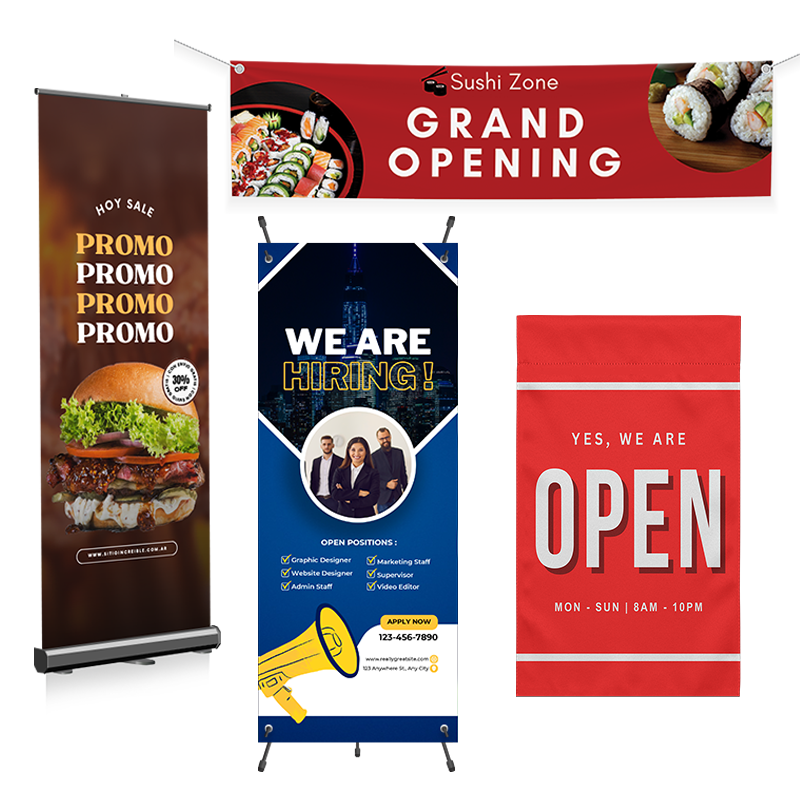
Material Selection and Environmental Considerations
Your vinyl choice affects both durability and visual impact. Understanding material properties helps optimize both cost and performance for different applications.
Cast vs. Calendared Vinyl
Cast Vinyl (Premium Choice):
7-10 year outdoor lifespan
Conforms to curves and complex surfaces
Superior color retention
Best for vehicle wraps and architectural applications
Cost: 40-60% higher than calendared
Calendared Vinyl (Standard Choice):
3-5 year outdoor lifespan
Ideal for flat surfaces
Good color options
Perfect for temporary promotions
Most cost-effective option
Weather-Specific Design Adjustments
High-Wind Areas:Use mesh vinyl or add strategic perforations to reduce wind load by 30-40%. This prevents tearing and extends sign life significantly.
High-UV Environments:Choose UV-stable inks and laminates. Consider lighter colors that reflect heat rather than absorbing it. Dark colors can fade 50% faster in intense sunlight.
Temperature Extremes:Account for expansion and contraction. Leave 2-3% extra material around edges for thermal movement.
ADA Compliance and Accessibility Design
Creating accessible signage isn't just legally required for many businesses – it expands your potential audience and demonstrates social responsibility. ADA-compliant design often improves usability for everyone.
Critical ADA Requirements
Mounting Height: 48-60 inches from floor to center of signColor Contrast: Minimum 70% contrast between text and backgroundFont Requirements: Sans-serif fonts, minimum 5/8 inch character heightTactile Elements: Grade 2 Braille for permanent room identification
Beyond Basic Compliance
Enhanced Accessibility Features:
Audio QR codes for visually impaired users
Multiple language options for diverse communities
Pictogram supplements for non-readers
Large print versions (150% larger than standard)
Universal Design Benefits:Signs designed for accessibility often perform better for all users. High contrast improves readability in poor lighting, while simple fonts reduce cognitive load for everyone.

Digital Integration and Smart Signage
Modern vinyl signage increasingly integrates with digital marketing campaigns, creating measurable results and enhanced customer experiences.
QR Code Integration Best Practices
Optimal Size: Minimum 1.2 inches square for smartphone scanningPlacement: Bottom-right corner (follows natural eye movement)Contrast: Dark QR code on light background (never reverse)Call-to-Action: "Scan for instant info" or "Get exclusive offers"
QR Code Success Metrics:
23% average scan rate for well-designed vinyl signs
43% higher engagement versus signs without QR codes
67% prefer QR codes over typing URLs
Social Media Integration
Hashtag Strategy:
Include branded hashtags on business advertising flags
Keep hashtags under 15 characters for easy reading
Place social media handles prominently but not dominantly
Photo Opportunities:Design signs that encourage social sharing. Include space for user photos or create Instagram-worthy backgrounds within your signage design.
Cost-Optimization and ROI Measurement
Understanding the true cost of vinyl signage includes design, materials, installation, and maintenance over time. Strategic choices can improve ROI by 200-300%.
Budget-Friendly Design Strategies
Single-Color Designs: Reduce costs by 40-50% while maintaining impactStandard Sizes: Use common dimensions to avoid custom cutting feesBulk Orders: Order multiple signs simultaneously for 15-25% savingsTemplate Designs: Adapt proven layouts to reduce design costs
ROI Measurement Techniques
Direct Metrics:
Customer inquiries mentioning the sign
Foot traffic increases (pre/post installation)
Sales increases in promoted products/services
QR code scan analytics
Indirect Metrics:
Brand recognition surveys
Social media mentions and photos
Customer retention improvements
Local search ranking improvements
Common Design Mistakes to Avoid
Learning from others' mistakes saves time, money, and frustration. These common errors appear in 60-70% of ineffective vinyl signage.
Critical Design Errors
Information Overload: Including too much text reduces message retention by 45%Poor Color Contrast: Low contrast can reduce readability by 60% in outdoor conditionsWrong Font Choices: Decorative fonts decrease comprehension by 35% at viewing distances beyond 8 feetInadequate Sizing: Text smaller than optimal reduces effectiveness by 50%
Installation and Placement Mistakes
Wrong Mounting Height: Signs mounted outside 48-60 inch range lose 25% of their readershipPoor Background Consideration: Busy backgrounds reduce message clarity by 40%Inadequate Lighting: Signs in poor lighting conditions perform 55% worse than well-lit equivalentsWind Load Ignorance: Improper wind consideration causes 30% of outdoor sign failures
Outdoor vinyl banner promoting an open day event for Tresham College attached to a metal fence
Advanced Design Software and Tools
Professional-quality custom adhesive vinyl signs require appropriate design tools. While basic software works for simple projects, advanced features significantly improve results.
Professional Software Options
Adobe Illustrator (Industry Standard):
Vector-based for infinite scalability
Pantone color matching
Advanced typography controls
Monthly subscription: $22.99
CorelDRAW (Alternative Professional):
Similar features to Illustrator
One-time purchase option available
Excellent for Windows users
Strong vinyl cutting integration
Free Alternatives:
Canva Pro: Templates and easy interface ($14.99/month)
Adobe Express: Basic design tools (free tier available)
GIMP: Advanced editing capabilities (completely free)
Design Workflow Optimization
Step 1: Research competitor signage and identify differentiation opportunitiesStep 2: Create mood boards with color schemes and font combinationsStep 3: Design 3-5 variations and test with target audience focus groupsStep 4: Refine based on feedback and prepare print-ready filesStep 5: Create installation guidelines and maintenance schedules
Cultural Considerations for Global Businesses
International businesses must consider cultural color associations and reading patterns when designing signage for diverse markets.
Color Cultural Variations
Red Associations:
Western cultures: Danger, excitement, passion
Asian cultures: Good fortune, prosperity, celebration
Middle Eastern cultures: Danger, caution
Blue Interpretations:
Global positive: Trust, stability, professionalism
Some cultures: Coldness, sadness
Generally safe across most markets
Green Meanings:
Western: Nature, growth, money
Islamic cultures: Sacred, peaceful
Some Asian cultures: New beginnings
Reading Pattern Considerations
Left-to-Right Cultures: Use Z-pattern layout described earlierRight-to-Left Cultures: Mirror the Z-pattern for Arabic, Hebrew marketsTop-to-Bottom Cultures: Consider vertical layouts for some Asian markets
Future Trends in Vinyl Signage
The vinyl signage industry continues evolving with new technologies, materials, and design approaches. Understanding emerging trends helps future-proof your investment.
Technology Integration
Smart Vinyl: Integration with NFC chips and IoT sensorsAugmented Reality: AR-enabled signs that display additional content through smartphone appsDynamic QR Codes: Codes that update content without physical sign changesSolar Integration: LED-backlit vinyl signs powered by integrated solar panels
Sustainability Focus
Eco-Friendly Materials: Bio-based vinyl from renewable sourcesRecyclable Options: Vinyl formulations designed for end-of-life recyclingReduced Waste Printing: Advanced cutting techniques minimizing material wasteLocal Production: Reduced shipping distances through distributed manufacturing
Design Evolution
Minimalism Trend: Continued movement toward cleaner, simpler designsInteractive Elements: More touchable and scannable sign featuresPersonalization: Variable data printing for location-specific messagesMotion Graphics: Static signs that create illusion of movement
Measuring Success and Continuous Improvement
Effective vinyl signage requires ongoing measurement and refinement. The most successful businesses treat signage as an iterative marketing channel.
Key Performance Indicators
Immediate Metrics (0-30 days):
Installation completion rate
Initial customer feedback
Social media mentions and photos
QR code scan volume
Short-term Metrics (1-6 months):
Foot traffic changes
Sales attribution
Brand recognition improvements
Customer inquiry volume
Long-term Metrics (6+ months):
Sign durability and maintenance needs
ROI calculation completion
Market share changes in service area
Customer lifetime value improvements
Continuous Optimization Strategies
A/B Testing: Test different messages, colors, or placements with similar signsSeasonal Updates: Rotate messages or colors based on seasonal relevanceCompetitor Analysis: Monitor competitor signage and identify opportunitiesTechnology Upgrades: Gradually incorporate new features like QR codes or better materials
Colorful vinyl banners showcasing custom printing services and promotional materials for business advertising
Implementation Roadmap for Success
Creating effective custom adhesive vinyl signs requires systematic planning and execution. This roadmap ensures professional results while avoiding common pitfalls.
Phase 1: Strategic Planning (Weeks 1-2)
Define specific objectives and success metrics
Research target audience preferences and behaviors
Analyze competitor signage in your market area
Establish budget parameters and timeline expectations
Phase 2: Design Development (Weeks 3-4)
Create initial concepts following guidelines in this article
Test color combinations and font readability
Develop 3-5 design variations for evaluation
Gather feedback from target audience focus groups
Phase 3: Technical Preparation (Week 5)
Select appropriate vinyl materials for your environment
Prepare print-ready files with proper bleed and resolution
Coordinate with installation professionals
Plan maintenance and cleaning schedules
Phase 4: Installation and Launch (Week 6)
Oversee professional installation following ADA guidelines
Document installation with photos for future reference
Begin tracking performance metrics immediately
Share installation on social media channels
Phase 5: Monitoring and Optimization (Ongoing)
Track all KPIs established in Phase 1
Gather customer feedback through surveys and observations
Plan updates and improvements based on performance data
Document lessons learned for future signage projects
Conclusion: Creating Vinyl Signs That Drive Results
Successful custom adhesive vinyl signs combine artistic vision with strategic thinking, technical expertise, and ongoing optimization. The businesses that achieve the best results treat their signage as a long-term marketing investment rather than a one-time expense.
By applying the psychology-based design principles, technical specifications, and measurement strategies outlined in this guide, you'll create printed promotional materials and business advertising flags that not only capture attention but drive meaningful business results.
Remember that great vinyl signage design is both an art and a science. While creativity matters, data-driven decisions and adherence to proven principles consistently produce superior outcomes. Start with clear objectives, design with your audience in mind, and continuously measure and improve your results.
The investment you make in professional vinyl signage design pays dividends through increased visibility, enhanced brand perception, and measurable business growth. Your signs are often the first impression customers have of your business – make them count.


Comments